The part of London that I live in was forested not so very long ago. There are still some substantial woods nearby and there were ancient wells too. After the Great Exhibition of 1851, the Crystal Palace, in which the exhibition had been housed, was dismantled and moved to this part of London and the area where it was relocated was renamed Crystal Palace. The park which was established at the same time that the Crystal Palace was relocated was a favourite place for Sunday afternoon walks when I was a child. Unfortunately, I never saw the Crystal Palace itself because it burned down in 1936, although its foundations could still be seen and were a reminder of a British achievement.
The Great Exhibition was an incredible success. Although only open for 6 months, it attracted more visitors than the Millennium Dome managed in a year. And this was at a time when travel was nowhere near as easy as it is today. The Great Exhibition also created a lasting legacy for the country, for with the proceeds from the entrance money a group of museums were built. Those museums were built in South Kensington and are located on Exhibition Road, named so that we should never forget where their origins were.
The museums are the Natural History Museum, the Science Museum, and the Victoria and Albert Museum. They are world-renowned, and rightly so, and are testament to the vision of Prince Albert and his idea of an exhibition to show what man had achieved through hard work, ingenuity and innovation.
To make sure that I don't sit at home getting more and more depressed on a day that is difficult for me to cope with, I have decided to get out my Oyster card, ignore the fact that it is a miserable day and I am going to get wet while walking to the bus stop and from the Underground station, and I am going to visit one of these museums.
I haven't made up my mind which it will be yet. They all have exhibits that I want to see; I shall make my decision when I get there. And I'll let you know about my day out later.
Friday, 15 May 2009

Thursday, 14 May 2009
Coincidences
I'm having a difficult time with depression at the moment. I've been feeling very low for a number of weeks, I am feeling abandoned after the ending of psychotherapy, and tomorrow would have been my wedding anniversary (the 11th since my husband died and they don't get any easier).
At the moment I am finding it difficult to summon up the enthusiasm to do anything and I am finding it very difficult to concentrate so anything that requires thought to enable it to happen is proving difficult. As a result, television is one of the few things that I can cope with, but even then I am selective about what I watch.
There wasn't much that attracted my eye when I looked to see what was on tonight. The only thing that remotely interested me was on BBC 2. It is entitled Keep it in the Family, and tonight's programme is about the Chapman family who own the Castle Hotel in Taunton. Privately-owned hotels such as this one, which has an international reputation, are rare these days, and the Castle Hotel also has a reputation for the food it serves. Gary Rhodes is a former employee. The owner of the hotel, Kit Chapman, believes that it is important that guests receive a warm welcome on arrival, and it is he who has been responsible for the hotel's well-deserved reputation.
But I can't watch this programme at the moment. I shall have to leave it for a few days and then watch it on BBC iPlayer. There is a reason. It is one of those coincidences that can make life really difficult for us.
The Castle Hotel in Taunton is where I spent my honeymoon.
Wednesday, 13 May 2009
How Did I Forget About Music?
I like music. Okay, so it's probable that most people, unless they are tone deaf, like music of some sort or other. I have quite wide-ranging, but specific, likes and dislikes.
Let's get the dislikes out of the way first. I hate jazz. All jazz. It does absolutely nothing for me. I also dislike most present-day pop music. I was growing up in the 60s and started working in 1972, so I had the luck to be listening to the best pop music that there has been in my formative years and this probably explains why I have little time for, or inclination to listen to, what passes for popular music today. Some of it is just poor versions of the songs that I grew up with and I find that much of the rest is just downright awful.
My taste in pop music, as I have said is predominantly from the period from the 60s to perhaps the mid-80s, but I do love some from both earlier and later than those dates. My particular favourites are The Beatles, Queen, Cat Stevens (both from the 60s and his more recent music as Yusuf Islam), Simon and Garfunkel (perhaps it is stretching the point a little to refer to their music as pop, but the Bridge Over Troubled Water Album was a phenomenal best-seller in its day), The Carpenters, Abba, Elton John, and not much at the time but they have grown on me over the years, David Bowie and The Rolling Stones.
I like music from the shows. Not all of them admittedly, but I do admit to enjoying listening to Phantom of the Opera, Les Miserables, Chess, Evita, Mack and Mabel, Oliver (my preferred recording being that of the Original London Cast from the original 1960s production with Georgia Brown in the role of Nancy, because Lionel Bart wrote Nancy's songs with Georgia in mind and they are written for her voice range), and a number of others. When my husband was alive we often went to see a show in the West End, and some we went to a number of times because we enjoyed them so much.
I also like classical music. Again not all of it, and not necessarily all the work of particular composers. Elgar is perhaps my favourite composer, probably because I think that much of his music perfectly evokes a picture of the English countryside when you hear it. I also really enjoy listening to work by Handel, Beethoven, Tchaikovsky, Mendelssohn (especially his violin concerto), Chopin, Bizet, Verdi, and some Bach and Mozart. These are my favourites, but I have listened to works by many more, and enjoyed them.
And that is perhaps the point. I have realized that my enjoyment of music seems to be something from the past. I rarely listen to the radio these days (I'm not sure why other than not liking much of the music that seems to be played today), and I haven't bought myself a new CD for years. I always had music playing in the car when I was driving about, but since I gave up using the car because of the rising price of petrol, I seem to have stopped listening to music almost completely.
But two programmes last Saturday evening on BBC 2 changed that. The first programme that I watched was The Birth of British Music, the first in a series of programmes presented by Charles Hazlewood and which focused on the music of Henry Purcell. I had forgotten just how much I enjoyed Purcell's music and I sat and enjoyed an hour listening to the story of his life and to some of his greatest music. And then just 40 minutes later, again on BBC 2, we were treated to Bill Bailey's Remarkable Guide to the Orchestra. While not altogether a fan of Bill Bailey, I have to say that I truly enjoyed this programme, and perhaps the highlight for me was the 'Cockney Arrangement' (well I am London born and bred) of the Finale to Rossini's William Tell Overture.
(Lily has just reminded me of another brilliant item in this programme. Bailey's brilliant interpretation of the theme to Doctor Who in the style of Jacques Brell complete with French lyrics about Docteur Qui.)
BBC iPlayer is wonderful. My only regret is that so many programmes are only available for 7 days. For since watching these two programmes on Saturday night, I have used BBC iPlayer to watch the Bill Bailey programme twice more and the Purcell programme another three times. And I'm actually thinking of watching it again later this afternoon just for the joy of listening to the music.
Watching these two programmes has reminded me just how important music has been in my life and has encouraged me to listen to it a little more often. There wasn't much that I wanted to watch on television last night so I got out my iPod, put in the earplugs, and sat listening to Queen while I got on with my knitting. And on Saturday I shall be sitting in front of the television, ready for the second programme in The Birth of British Music series, for it is about Handel, who for all that he was born German, wrote music that is seen very much as being British. I can feel myself being rowed along the Thames to the Water Music, watching a display in the night-time sky to the Music for the Royal Fireworks, and thrilling to the Hallelujah Chorus as I sit here and write this. Imagine what I will be like when the programme is actually on and I am really listening to the music.
Tuesday, 12 May 2009
Some More Of My Handiwork
One of the things that I do to keep my mind occupied when I am very depressed is knitting. I have often talked about what I am working on at the time on this blog and I thought that I would show you what I have done over the last couple of days.

I had a couple of balls of wool left over from a cardigan that I have just made and thought that it would be nice to have a hat. I wanted a simple beanie hat but I couldn't find a free pattern for a hat I liked on the Internet so I decided to see if I could work out something for myself. And this is the result.
 As the hat had used less than one of the balls that I had left I decided to knit a second hat. This is it. One of the beautiful aspects of this wool is that no two balls are the same, so my two hats are quite different in appearance.
The cardigan that I knitted is an incredible array of colours and I have nicknamed it my 'coat of many colours'. The predominant colours are red and blue, but there are many others too including yellow, green, purple and pink.
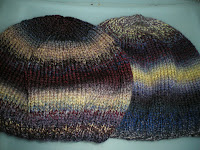 Here are the two hats side by side. The first one I knitted is on the right and has blue as a more predominant colour, while the second hat, on the left in this picture, is more obviously red.
The difference in the hats when viewed together is quite striking and yet, when viewed separately, they don't look that different.
It is the complexity of knitting yarns like this one that make knitting such an enjoyable pastime for me. Having knitted practically all my life, the thing that I appreciate most these days is the diverse nature of the knitting yarns available today. Such a choice, and range, was unheard of when I was younger, and I believe that it is this choice that I have, plus the exciting range of patterns available, that has meant that knitting has become such a lifeline for me.

However, sometimes I need a change from knitting, not least because I have quite bad osteo-arthritis in the index finger of my left hand and sometimes the pain can become so bad that knitting becomes very difficult. I am having problems at the moment, so yesterday I started work on a cross stitch sampler. It is of African animals and will provide me with a reminder of the time that I spent in a game reserve in South Africa when I went to stay with my aunt (she is my Dad's twin sister and my godmother and has lived in South Africa most of her life) shortly after my husband died.
The trouble with a project like this is that it takes a lot longer to complete than knitting a cardigan or a jumper. But the satisfaction when it is completed will be just as great and when framed will provide me with a permanent reminder of something that I am sure that I will never be able to do again. And yes, I did see all of these animals and many more besides.

I had a couple of balls of wool left over from a cardigan that I have just made and thought that it would be nice to have a hat. I wanted a simple beanie hat but I couldn't find a free pattern for a hat I liked on the Internet so I decided to see if I could work out something for myself. And this is the result.
 As the hat had used less than one of the balls that I had left I decided to knit a second hat. This is it. One of the beautiful aspects of this wool is that no two balls are the same, so my two hats are quite different in appearance.
The cardigan that I knitted is an incredible array of colours and I have nicknamed it my 'coat of many colours'. The predominant colours are red and blue, but there are many others too including yellow, green, purple and pink.
 Here are the two hats side by side. The first one I knitted is on the right and has blue as a more predominant colour, while the second hat, on the left in this picture, is more obviously red.
The difference in the hats when viewed together is quite striking and yet, when viewed separately, they don't look that different.
It is the complexity of knitting yarns like this one that make knitting such an enjoyable pastime for me. Having knitted practically all my life, the thing that I appreciate most these days is the diverse nature of the knitting yarns available today. Such a choice, and range, was unheard of when I was younger, and I believe that it is this choice that I have, plus the exciting range of patterns available, that has meant that knitting has become such a lifeline for me.

However, sometimes I need a change from knitting, not least because I have quite bad osteo-arthritis in the index finger of my left hand and sometimes the pain can become so bad that knitting becomes very difficult. I am having problems at the moment, so yesterday I started work on a cross stitch sampler. It is of African animals and will provide me with a reminder of the time that I spent in a game reserve in South Africa when I went to stay with my aunt (she is my Dad's twin sister and my godmother and has lived in South Africa most of her life) shortly after my husband died.
The trouble with a project like this is that it takes a lot longer to complete than knitting a cardigan or a jumper. But the satisfaction when it is completed will be just as great and when framed will provide me with a permanent reminder of something that I am sure that I will never be able to do again. And yes, I did see all of these animals and many more besides.
Monday, 11 May 2009
It Wasn't How I Expected Or Wanted It To Be
I deliberately held off writing a post about the end of therapy until I'd had a few days to get used to the idea. On Friday, after my final therapy session, I was numb, but I knew that a huge factor in this emotion was that I had not managed any sleep at all on Thursday night.
The session itself was strange and not at all how I expected it would be or how I hoped it would be. It started with me being asked how I was. That was fairly easy to answer because I was incredibly tired so I told my therapist that I hadn't had any sleep at all the previous night. He queried this. Was I sure that I hadn't dropped off at some point? Yes, I was sure, and I proceeded to tell him all the things that I had done in an effort to get some sleep.
He then asked me what my feelings were about the end of therapy. I told him that I regretted the end of the one bit of routine in my life, that I was scared about not having the regular contact with another human being that the therapy appointments guaranteed, and that I had an overwhelming feeling of being abandoned.
And that is how I feel now. Abandoned. Left on my own again. It was not a good last session. There was no real ending. It was a conversation that was ended with "I'm afraid we'll have to leave it there" and a "Goodbye" and a handshake.
I'm not sure what I expected, but it wasn't that. I had hoped for some sort of closure, some hope for the future. Instead I feel as though I have something terminal and I am in the final stages. I feel as though I have just been left to die.
Friday, 8 May 2009
You Must Listen To This
One of the blogs that I read regularly is The Secret Life of a Manic Depressive. Seaneen Malloy is a brilliant writer and gives a real insight into what it is like to suffer from serious mental illness. Today's Afternoon Play on BBC Radio 4 was 'Dos and Don'ts for the Mentally Interesting', written by Louise Ramsden and based on Seaneen's blog.
If you didn't hear it, I can thoroughly recommend it. You can find it here.
If you didn't hear it, I can thoroughly recommend it. You can find it here.
The Early Hours Of The Morning
Okay, so it is nearly 2.30 in the morning and I am still awake. I've tried to get to sleep, using all the various methods that I can think of, but sleep just will not come.
Reading is usually one of the ways that I can guarantee will send me off into the arms of Morpheus, but not tonight. I've tried light-hearted reading material, and I've tried some real academic thought-provoking stuff that will normally induce sleep after about two paragraphs. Tonight it just isn't doing the job.
I've listened to music, I've listened to relaxation and sleep tracks; but my eyes are still wide open. It looks as though I will still be awake when the alarm goes off at 6am.
I rarely use an alarm. Friday mornings are the exception of course because of going for my psychotherapy session. This is the last session, so is this the reason that I can't sleep? It's possible, but I actually feel quite calm about that at the moment. But do I? I don't have butterflies, or pterodactyls, flying around in my stomach, nor am I suffering from the shakes (another sure sign that I am very worried about something), but even though I am telling myself that things will be all right I'm not sure that there isn't some little corner of my subconscious which is working overtime keeping me awake.
I'm not going to care about it; I'm going to try to relax; I shall read; I shall listen to music; I shall get up when the alarm sounds; I shall make the most of this last session; and I will remember to thank my therapist for the improvement that he has brought about in me.
Thursday, 7 May 2009
A 'Wellcome' Day Out
I haven't been sleeping very well recently. There is nothing new in that; it's something that I often write about. The problem is that when you can't sleep at night you find it very difficult to get through the day. You are tired, you have no energy, eventually you start having a nap to get through the day and before you know where you are, sleeping becomes something that you do during the day rather than at night, which is when it is supposed to occur. Yesterday morning I woke after a mere four hours sleep and I knew that if I didn't do something about it I would be asleep again in just a couple of hours, moving more and more towards being nocturnal. So I made an effort; even though I was tired I was going to do something that would help to tire me so that I could sleep last night.
I decided to make a foray into the centre of London and visit another museum. I wrote about a previous museum visit here, made for much the same reason, and it had worked reasonably well so why shouldn't I try it again. I knew that it couldn't be one of the major museums because I didn't really have the energy to walk (and stand) for hours so I chose something that was smaller, but nonetheless interesting. I visited the Wellcome Collection.
The permanent exhibitions are displayed in a couple of large rooms, but there is also an area where special exhibitions are held and at present there are two such exhibitions under the banner Art and Mental Illness. I did take a brief walk round one (Madness and Modernity - Mental Illness and the Visual Arts in Vienna 1900) but it was the permanent exhibitions that I was more interested in, and in particular the Medicine Man exhibition which includes artefacts from Sir Henry Wellcome's collection on the history of medicine and health.
It is not the largest exhibition in the world, but for someone who has studied the history of medicine it is fascinating. There are paintings, photographs, artificial limbs, medical instruments, items relating to old therapies like cutting and bleeding, diagnostic dolls, Japanese sex aids, momento mori, amulets to ward off disease and evil spirits, items used by famous men, the mummy of a child sacrifice from Peru, and a shrunken head. It is a classic example of a Victorian collection of artefacts gathered together by a man with a passion.
I was able to while away a couple of hours looking at these artefacts and reading about them. I walked and stood, I was amazed and a little reviled, I was informed, educated and interested. The exhibition did what a good exhibition should; it allowed me to learn about a subject, and to learn a little about the man who put the collection together. It made me want to find out more.
Walking was a significant factor in the day; I walked miles. I got on a bus not far from my home and got off when it reached the end of its route. I could have got another bus almost to the doorstep of the Wellcome Trust, but I chose to walk for I knew that the exercise would do me good and help to tire me. I walked around the collection and then I walked to find somewhere for a quick lunch before walking further to a point somewhere on the route of the bus to take me home. And then after reaching the bus stop near my home I walked some more as I went to collect a prescription from my GP's surgery and then to the chemist's to get it filled. Finally I walked the last mile home.
Yesterday evening was spent reflecting on my day out, and resting my aching legs and feet. I managed to stay awake, even though I was tired, until a reasonable time so that I stood a chance of sleeping last night. When I did go to bed I fell asleep fairly quickly and though I did wake momentarily a couple of times in the night, I was able to get back to sleep quickly and sleep through until a reasonable hour this morning.
I think that I achieved a reasonably successful outcome for the day.
Wednesday, 6 May 2009
I Will Not Panic; I Will Not Get Anxious
In less than 48 hours I will be setting off for my last psychotherapy session. I have often written on this blog how difficult I find it during the days before each session, though at the moment I am quite calm. But Friday morning may be a slightly different matter.
The termination of psychotherapy should mean the end of my sleepless Thursday nights but it also means the end of the one routine item in my otherwise empty life. Friday mornings have meant a regular opportunity to talk to another human being, and most importantly to be able to talk to someone who genuinely wants to know how I am rather than the question just being a platitude.
Yes, I have a couple of friends with whom I correspond by email on a daily basis, and both of them (and they know who they are) do much to encourage me and to help me get through my dark periods. But they are both many miles away and so actually seeing them and talking face to face is a rare thing.
I am telling myself that the psychotherapy has made a difference to me. It has helped me to see that it is not my fault that I am ill, that I am not responsible for how I feel, that things in my past have made it difficult for me to deal with how I am today. Medication helps with the panic and the anxiety, but it does not help with the loneliness and the empty feelings. Talking has helped with them, but I now have to see if I can cope with them on my own. And that is the most difficult part of depression to deal with; the isolation and emptiness. The end of therapy feels like I am being abandoned yet again.
Friday, 1 May 2009
One More Session To Go
Today was my penultimate psychotherapy session. It was difficult; in fact, it was very difficult. I know that I am not ready for it to end, but end it must because that is the way of things on the NHS. There is never enough of what is needed.
As a former manager myself (though not in the NHS) I am well aware of the necessity of management of some kind, but I wonder how much more could be done for the patients' benefit if the multiple levels of management and the ridiculous amount of paperwork, results tables, protocols, and sundry other government and management requirements were to disappear overnight.
Mental health has always been a poor relation. It is not glamorous, nor is it seen as being of significant importance to this country. Yet the fact is that approximately 25% of the population will suffer with mental health problems at some time in their life, and a significant proportion of the population is unable to work because of mental health problems means that is should be seen as important. It is likely that the proportions will rise over the next couple of years because of the global financial crisis which has resulted in so many losing their jobs and the uncertainty that so many others feel.
As with everything else, this government has promised to do something about mental health provisions and yet their solution is far in the future and a least cost option. There is much evidence to show that psychotherapy can do much to make a change to the lives of those with mental health problems, particularly depression. But it is necessary to ensure that the right sort of therapy is provided for those that need it; and it needs to be available from the start, not when the situation has become so bad that the sufferer cannot work and their life has fallen apart. The government plans for there to be 10,000 therapists offering CBT in the next few years, but the Layard Report which brought about this decision by the government actually said that 30,000 were needed and that was before the financial crisis which is likely to increase the number of those needing help.
And CBT is not the global panacea that many seem to think it is. I am sure that it does help some people, but what is not widely reported is the number of people who are made well for a few months but then regress and have to rejoin the waiting lists for treatment of some kind. There is no point in offering a treatment that encourages people to change their thinking about the here and now if it is the long-distant past that is the root cause of their problems.
I know that I have been lucky. I have been receiving psychodynamic psychotherapy for a year now and it has made a significant difference to me. I have started to regain some of my self-confidence, and my weekly appointments have meant that there has been a little bit of routine in my life which has helped me get some structure in my life. But I know that there is still much work to be done to deal with the problems that led to me becoming ill. I need to understand how things that happened to me long ago and of which I had no conscious knowledge can be put behind me and I need to be helped to move on with my life. However, that is not going to happen because next week I will be saying goodbye to my therapist and I will be left on my own. I am being abandoned. Not because I am 'cured' but because the resources are not there to help those who need help.
Subscribe to:
Posts (Atom)